
In the field of food production, safety is always an inviolable bottom line. When talking about autoclaves, many people first think of sterilizing petri dishes and test tubes in laboratories, but their applications go far beyond that. Today, we are going to reveal the all-round applications of autoclaves in the food industry, and see how this “invisible guardian” ensures the safety of our food.
Exclusive to the food industry: counter-pressure autoclaves—what does the “counter-pressure” mean?
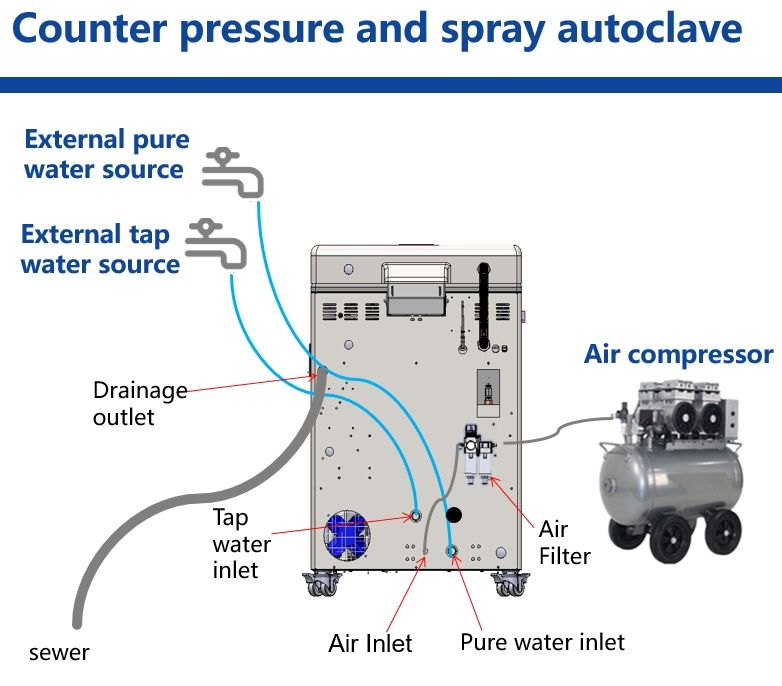
As the name suggests, the key feature of a counter-pressure autoclave lies in its counter-pressure design. Based on conventional high-pressure sterilization, it is equipped with a pressure balance control system. During the sterilization process, it not only injects high-pressure steam into the sterilization chamber, but also pumps in compressed air or nitrogen during the cooling phase. This keeps the pressure inside the sterilization chamber consistently higher than that inside the food, thereby preventing issues like deformation, rupture, and juice loss caused by internal-external pressure differences.
Counter-pressure autoclaves: these foods cannot do without their protection
With the advantages of controllable pressure and uniform temperature, counter-pressure autoclaves have become indispensable equipment in the production of various foods, and are particularly suitable for the following product categories:
Low-acid canned foods: Such as canned meats, canned fish, and canned beans. These foods have a pH value ≥ 4.6, which makes them a breeding ground for pathogenic bacteria like Clostridium botulinum, and thus require high-temperature sterilization at temperatures above 121°C. However, when cans are heated, the evaporation of internal moisture generates pressure; if the external pressure is insufficient, the cans are prone to swelling, deformation, or even explosion. By balancing the internal and external pressures, counter-pressure autoclaves not only ensure that the sterilization temperature meets the standard, but also maintain the intact shape of the cans.
Soft-packaged foods with soup: For example, bagged marinated products, vacuum-packed soups, and ready-to-eat bean products. These foods have high water content and are mostly packaged in flexible plastic or aluminum foil bags. During heating, the steam generated inside can easily cause the packages to bulge and rupture. In the cooling stage, counter-pressure autoclaves maintain pressure by injecting compressed air, which can effectively prevent package bursting and avoid soup overflow due to sudden pressure drop.
Sealed liquid foods: For the sterilization of liquid foods such as fruit juice, milk, and soup, counter-pressure autoclaves can complete the sterilization process in a short time through precise temperature and pressure control, maximizing the retention of the food’s nutritional components and original flavor.
From labs to production lines: the cross-industry value of autoclaves
From being a “research assistant” in microbiology laboratories to a “quality guardian” in the food industry, the application scenarios of autoclaves continue to expand. As a customized solution for the food industry, counter-pressure autoclaves use their unique pressure balance technology to solve the pain points in food sterilization, enabling us to enjoy a wide range of processed foods that are safe, delicious, and have a long shelf life.







































ZEALWAY provides quality autoclaves, full services and professional sterilization solutions for you.

Leave a Reply